Pump.fun App Review: Fees, Callouts, Rewards and How It Works
The launchpad's own app turned into a social trading app this year, and in October it started charging — and paying — differently.
What is the Pump.fun app?
The Pump.fun app is the official trading app of Pump.fun, the Solana memecoin launchpad, for iPhone, Android and the web, and since August 2026 it has been a social trading app. You follow traders and read their callouts — public calls on coins they hold — then buy with Apple Pay, Google Pay or a crypto deposit into a self-custodial wallet created by Privy. Callers whose callouts lead other users to trade earn daily USDC from Pump.fun's Callout Rewards pot. Every trade in the app or on pump.fun pays a 0.45% platform fee, or 0.40% with a referral code such as BullishTBH, plus a Solana network fee and the pool fees any app pays on Pump.fun coins. The app also offers limit orders, perpetual futures through Hyperliquid and tokenized stocks, the last two limited by region, and it is unavailable in the UK.
Referral link — SellThePump earns a credit if you use it, at no extra cost to you.
From launchpad companion to social trading app
For most of its life, Pump.fun was the place coins were born and other apps were where people traded them. Fomo built a social trading business largely on Pump.fun coins, and Axiom built a terminal around them. In 2026 Pump.fun went after that layer itself, shipping weekly and documenting it in its own newsletter. The milestones that matter:
- July 2026 Robinhood Chain trading, a redesigned app, balances shown in USDC, and Apple Pay buys straight into about 300 coins.
- August 7 Social trading goes public: callouts, follows, and a feed of the people you follow.
- August 13 Callout Rewards: callers paid daily in USDC when their calls lead other users to trade.
- Late August HyperEVM trading for everyone; Pump.fun reports the app passing 100,000 daily active users.
- September 1 Limit orders: take profit and stop loss.
- September Squads, direct messages, Custom Pairs, Holder Rewards, and a deposit-match referral program.
- Late September Robinhood tokenized stocks, outside the US, UK, Switzerland and Canada.
- October 3 New Trending and Stocks feeds, and a $200,000 trading competition split between solo traders and squads.
- October 17 A 0.45% platform fee on app and web trades, 0.40% with a referral code, with part of it paid to referrers.
The last item changed the economics. Until October 17 the app advertised zero-fee trading on Solana; since then every trade pays the platform fee, and Pump.fun says the part of it that isn't paid to referrers goes into the Callout Rewards pot. The rest of this review covers what that looks like in the app.
A tour of the app
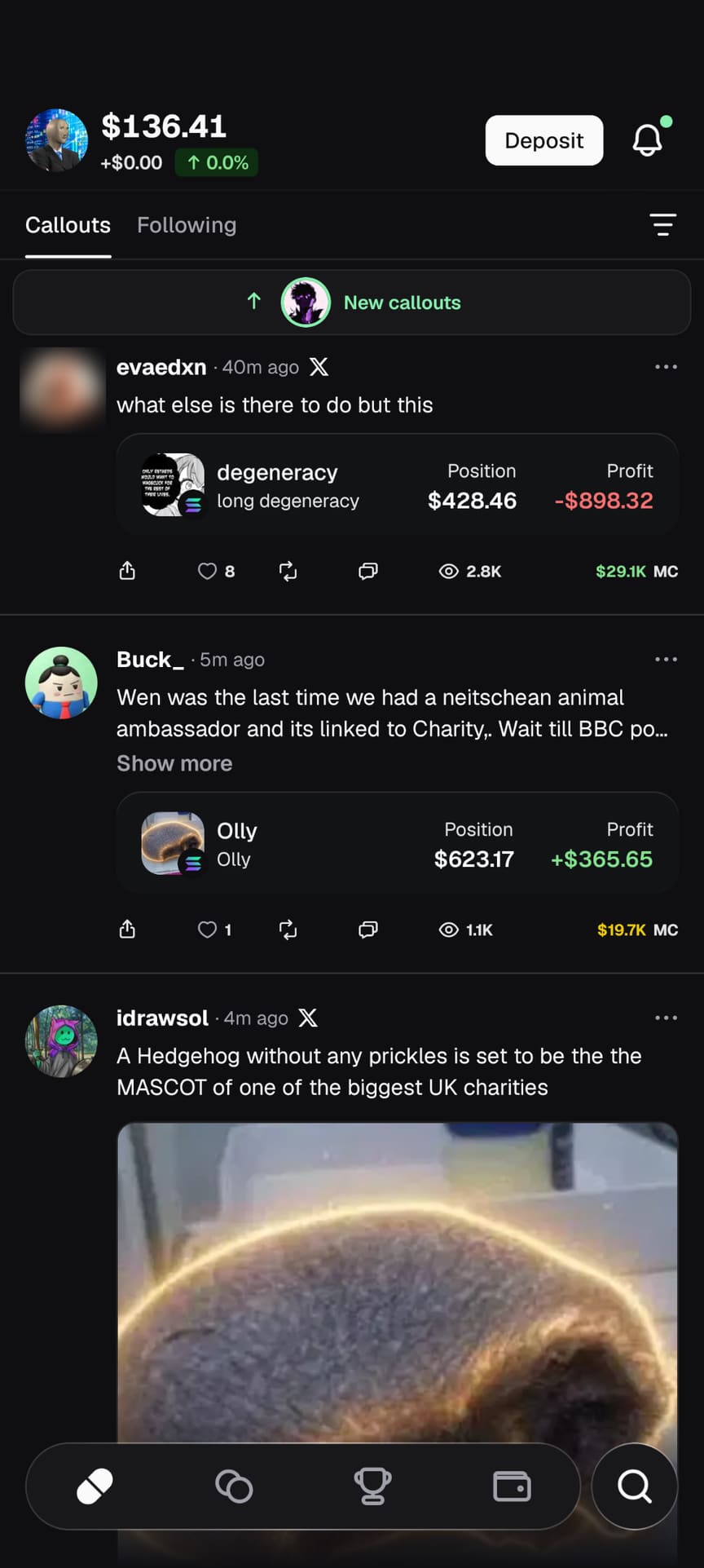
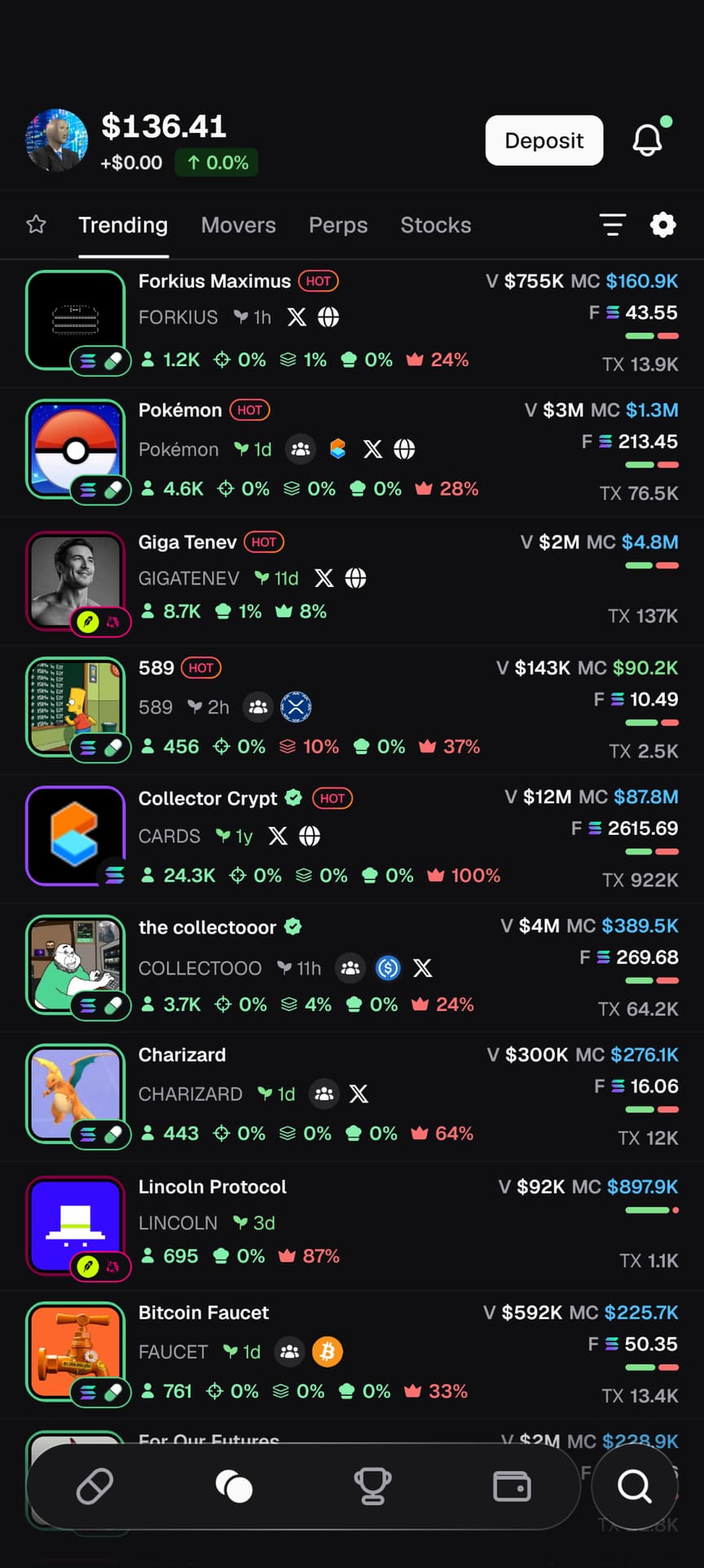
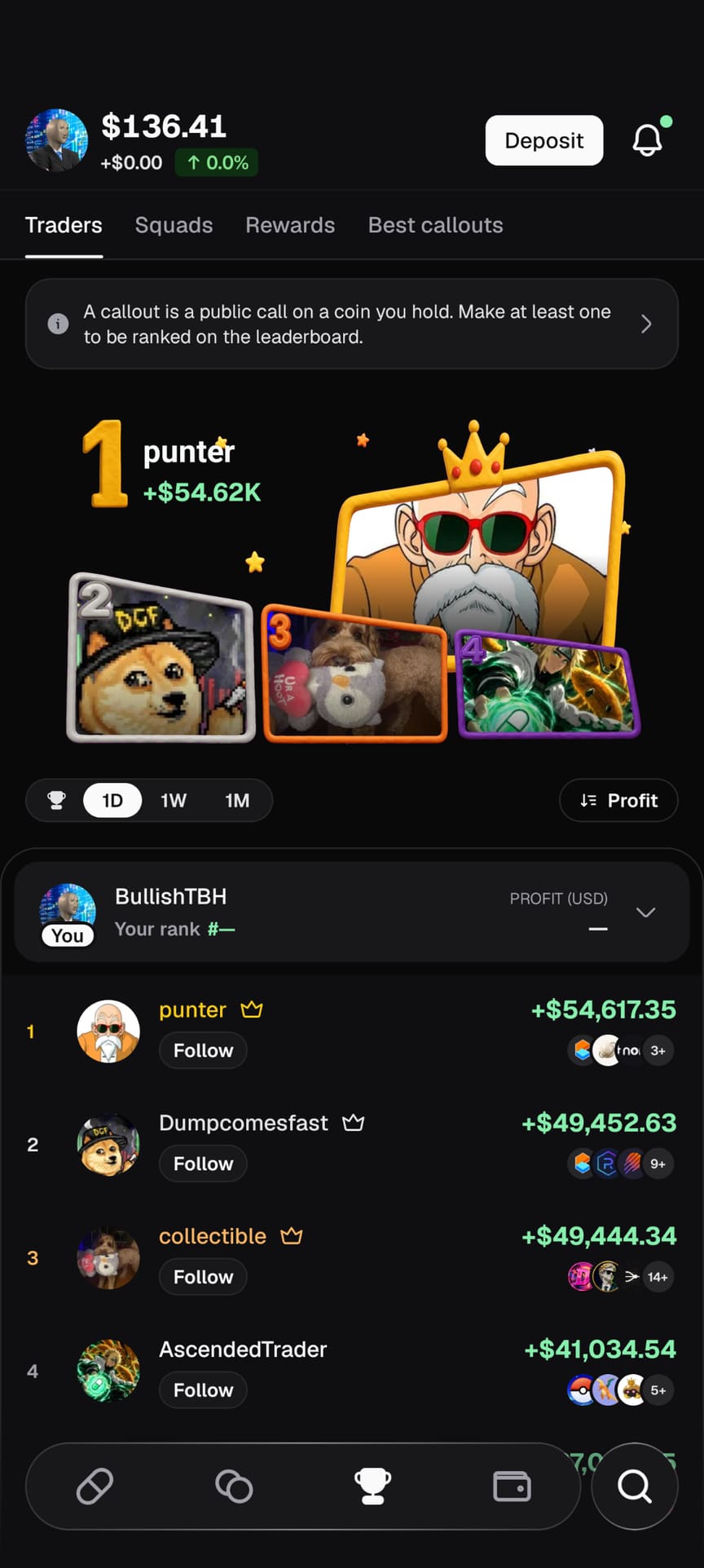
The screenshots below are from SellThePump's own Pump.fun account, taken in October 2026. One avatar of another user is blurred; usernames are public in the app.
Callouts: the home feed
The app opens on Callouts, with a Following tab beside it. Each post is a caller's message attached to a coin they hold, with their position size and their profit or loss on it, the coin's market cap, and the usual likes, reposts and view counts. An X badge marks callers who have linked an X account. What makes it different from a crypto Twitter timeline is that the position is shown next to the opinion: you can see whether someone is up on the coin they're calling, or sitting on a loss and hoping you'll buy.
Trending, Movers, Perps and Stocks
The discovery screen has four tabs. Trending and Movers rank coins by activity; each row carries the coin's age, links to its socials, its volume, market cap and transaction count, and a strip of holder statistics that shows how concentrated the supply is. Coins from outside Pump.fun appear here too, so the list covers Solana rather than only Pump.fun launches. Perps opens Hyperliquid perpetual futures and Stocks lists tokenized stocks — both are limited by region, covered further down.
Leaderboards
Four leaderboards — Traders, Squads, Rewards and Best callouts — each by day, week or month, sorted by profit by default. The app's own note explains the entry rule: "A callout is a public call on a coin you hold. Make at least one to be ranked on the leaderboard." Squads are invite-only groups with a shared profile and their own ranking.
Read leaderboards for what they are. A day's top trader is usually the person who took the largest position on the coin that ran, and the ranking includes unrealised profit, so a number at the top can shrink before anyone sells. They are a good list of people to watch and a poor reason to copy a position.
Profile and wallet
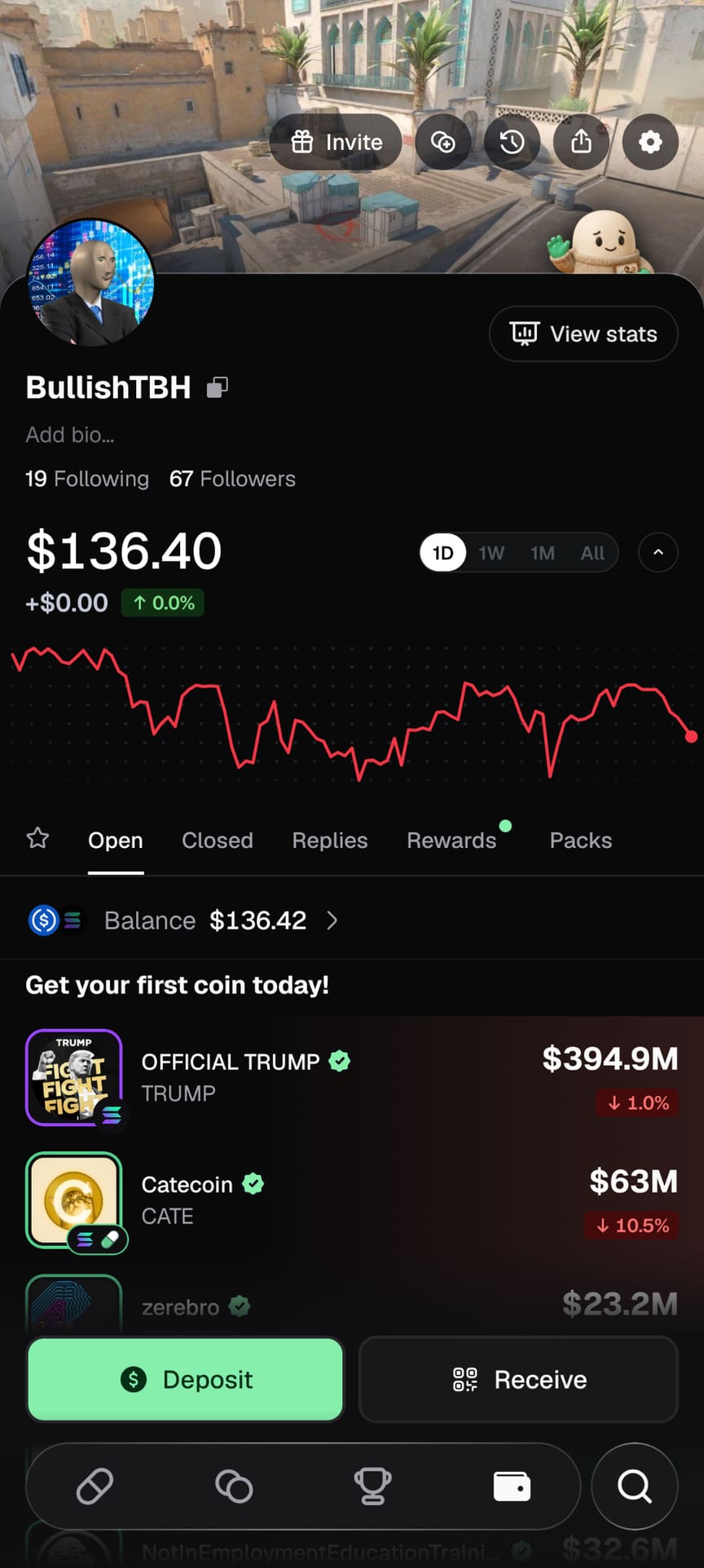
Your profile doubles as your wallet: balance and a performance chart up top, then tabs for open and closed positions, replies, rewards and packs. Deposit and Receive sit at the bottom, and the Invite button at the top opens the referral screen — your referral code is your username, which is why the code for this site's account is BullishTBH. Balances display in USDC by default, with a toggle to SOL.
The Rewards tab carries a line reading "Enter a referral code, pay 10% less" — one of two places to add a code after sign-up, the other being the fee details on the buy screen. Packs, beside it, is the app's version of the collectible-card gacha that Courtyard and Collector Crypt made popular: you buy a pack and open it to see which card you pulled. It is separate from trading, and this review doesn't cover it.
Callout Rewards: getting paid for calls
This is the feature that most sets the app apart. Pump.fun tracks which callouts users view, and when someone trades a coin after viewing yours, your callout earns a share of a daily pot paid in USDC, ranked against everyone else's. Pump.fun says it paid out nearly $20 million this way in the program's first two months, from a pot of around $300,000 a day, and that platform fees not paid to referrers now go into it.
The incentive deserves a clear look. A reward tied to how much trading a call drives is a reward for persuading people to buy, and the caller already holds the coin. Pump.fun's October 10 change acknowledges the problem: from that payout, it says rankings weigh whether followers actually profited more heavily than raw volume, and pay less on very small coins, where a single loud call moves the price most.
That is a real improvement, and it doesn't change what a callout is. Treat it as a lead to research, check the holder statistics and the caller's history, and size the trade as if nobody had called it at all.
Referral link — SellThePump earns a credit if you use it, at no extra cost to you.
Fees: what a trade on the Pump.fun app costs
Three layers. The platform fee is Pump.fun's charge for using its app or website. The network fee is Solana's, passed through to you as its own line. The pool fees are written into Pump.fun's smart contracts and paid on every trade of a Pump.fun coin, whichever app places it — so they are part of your cost on Fomo and Axiom too, and they leave any comparison between apps unchanged.
I checked the first two on this site's own account on October 20, 2026: a $10 USDC buy showed "Platform Fee 0.45%" and "Network Fee 0.159853 USDC" on the confirm screen, before I tapped buy.
| Fee | Rate | Where it applies |
|---|---|---|
| Platform fee | 0.45%, or 0.40% with a referral code | Trades in the Pump.fun app and on pump.fun, including limit orders and the first buy when you create a coin |
| Bonding-curve pool fee | 1.25% | Every trade of a coin still on its curve, in any app |
| PumpSwap pool fee | 1.25%, stepping down to 0.30% as market cap grows | Every trade of a graduated coin, in any app |
| Perps | Builder fee up to 0.10% of the order, plus up to 0.25% per bridge transfer | Hyperliquid perps in the app; Hyperliquid's own fees on top; the platform fee is replaced by these |
| EVM trades | An extra 0.10–0.15% | Robinhood Chain and other EVM trades; Pump.fun pays the gas |
| Creating a coin | Network fee and a small SOL rent deposit | Launching in the app or on pump.fun |
| Solana network fee | Set by the network; 0.159853 USDC on a $10 test buy, October 20, 2026 | Every Solana trade, shown as its own line before you confirm. It can include a one-time rent deposit on a coin's first buy, which the app's Reclaim SOL tool returns after you've sold out of the coin |
Worked through: putting $100 into a coin still on its bonding curve costs $0.40 in platform fee with a referral code ($0.45 without) plus $1.25 in pool fee, about $1.65 before network costs. The pool fee is the bigger number, and you would pay it on any app. The platform fee is the part that differs between apps, and at 0.45%, or 0.40% with a code, applied as a percentage at every trade size, it is the lowest published platform fee of any app this site reviews.
The network fee is the line that changes the picture on small trades. On the $10 test buy it was 0.159853 USDC: about 1.6% of the trade, and more than three times the platform fee. Fomo pays Solana network fees itself and charges a minimum instead, so on trades of a few dollars Fomo can come out cheaper; from a few tens of dollars up, Pump.fun's lower rate makes it the cheaper app. Network fees move with Solana's load, so treat that figure as one reading rather than a price.
Two notes. Fees are set by Pump.fun and its terms let it change them at any time; the figures here are from its fee schedule dated October 17, 2026. And on thin, newly launched coins, price impact and slippage often cost more than every fee above combined — that cost is set by the market, not the app. Side-by-side numbers for other apps are in the fee calculator.
The referral code, briefly
A referral code on Pump.fun is another user's username, applied to your wallet. It moves your platform fee from 0.45% to 0.40%. Sign-up asks for one, and if you skipped it you can add one later from the Rewards tab on your profile or from the fee details on the buy screen. Added on a new account before your first fiat purchase in the app — by card, Apple Pay or Google Pay — it also qualifies you for Pump.fun's deposit match: up to $50, paid in installments as you trade on five separate days. SellThePump's code is BullishTBH, the username of this site's author.
Where to enter it, the timing rules, the full match terms and how to check it applied are on the Pump.fun referral code page, along with the disclosure of what the site earns from it.
Getting started
- 1
Install and sign in. Get "pump.fun - speculate on trends" from the App Store or pump.fun from Google Play, or use pump.fun in a browser. Sign in with email, Google, Apple or GitHub; one login covers the app and the website.
- 2
Add a referral code. Sign-up asks for one. If you skip it, the Rewards tab and the buy screen's fee details both let you add one later for the 0.40% rate; the deposit match needs it before your first purchase.
- 3
Fund the wallet. Buy with Apple Pay, Google Pay or a card through the in-app provider where it operates, or tap Receive and send SOL or USDC from another wallet or exchange. Only the in-app purchase counts toward the deposit match.
- 4
Follow before you buy. Follow a handful of traders, watch their callouts for a few days, and compare what they call with how it ends up.
- 5
Trade small, with exits set. Read the confirm screen — the platform fee and the network fee are each their own line — and set a take-profit and stop-loss with a limit order rather than relying on watching the chart.
Launching a coin from the app
The app is also the launchpad: anyone can create a coin from it with no platform fee, paying the Solana network fee and a small SOL rent deposit, while the first buy at creation pays the normal platform fee. How launches work after that — the bonding curve, graduation to PumpSwap, what creators earn and how few coins graduate — is covered in the Pump.fun trading guide, which is about the protocol rather than the app.
Pump.fun app vs Fomo, in one paragraph
They're now the same kind of product, and the choice comes down to price against depth. The Pump.fun app has the lower platform fee — 0.40% with a code against Fomo's 0.45%, and a percentage at every size where Fomo charges a minimum of up to 0.95 USDC on small Solana trades — plus Callout Rewards and the native launchpad. Fomo pays Solana network fees for you where Pump.fun passes them through, which can make Fomo the cheaper of the two on trades of a few dollars. Fomo has the more developed social layer, seven chains on one balance, US bank withdrawals and a cleaner corporate record. Fees, features and trust are compared line by line in Pump.fun vs Fomo.
Is the Pump.fun app safe?
Custody is the strong part. The wallet is created by Privy and stays under your control; Pump.fun's terms say it has no control over your wallet or its keys, and its App Store listing says it cannot access or freeze your funds. Since September 25, 2026, you sign in to the app and the website with the same email, Google, Apple or GitHub login rather than a browser wallet.
The company carries more history than its rivals. In May 2024 a former employee used privileged access to Pump.fun's systems to take about 12,300 SOL (roughly $1.9 million); Pump.fun upgraded its contracts and said affected users would be made whole. A US class action against Baton Corporation and its founders, Aguilar v. Baton Corporation, is ongoing: on August 31, 2026 a federal judge in New York allowed its RICO claims to proceed, which means the case continues, not that anything has been proven. The UK is on Pump.fun's prohibited list, and in September 2026 the iPhone app was pulled from new downloads in the US and India for a period before its US listing returned.
Who you're dealing with. Pump.fun is developed and maintained by Baton Corporation, which publishes the weekly newsletter cited on this page. The iPhone app's App Store listing names its seller as Maius Imperium Limited, and the Android app is published under the package name com.batonresearch.pump. Both are worth checking against the listing before you install, since lookalike apps are the commonest way people lose a wallet.
The common scam targets you, not the app. Pump.fun says it asks for a private key in exactly one place, the "Link email & socials" dialog inside your signed-in account. Anyone asking for a key or seed phrase anywhere else — a DM, a support chat, a site promising a bonus — is running a scam.
And the largest risk is the one no app removes: memecoins are volatile, the social layer rewards persuasion, and most traders lose money. Use a balance you can afford to lose.
Pros & Cons
Pros
- Lowest published platform fee of any app reviewed here — 0.45%, 0.40% with a referral code, no minimum
- Built by the team that runs the Pump.fun bonding curve: launch a coin and trade it in one app
- Callout Rewards pay callers daily in USDC when other users trade off their calls
- Self-custodial Privy wallet, with one login for the app and pump.fun on the web
- A referral code can be added after sign-up, where Axiom and Fomo take one only at sign-up
Cons
- More feeds and tabs than Fomo, so there is more to learn before it feels simple
- Solana network fees are passed through as their own line, where Fomo pays them, so trades of a few dollars can cost more than on Fomo
- Its social graph only dates from August 2026, so track records are shorter than on Fomo
- Brand-new pricing: the 0.45% fee began October 17, 2026, and Pump.fun can change it without notice
- Unavailable in the UK; perps exclude US residents, tokenized stocks exclude the US, UK, Switzerland and Canada
- A US class action against its company and founders is ongoing — a judge let its RICO claims proceed in August 2026 (allegations, nothing proven)
Frequently Asked Questions
What is the Pump.fun app?
The Pump.fun app is the official trading app of Pump.fun, the Solana memecoin launchpad, for iPhone, Android and the web. Since August 2026 it has been a social trading app: you follow traders, read their callouts, buy coins with Apple Pay, Google Pay or a crypto deposit into a self-custodial wallet, and can launch coins of your own. It is developed by Baton Corporation, the company behind the launchpad.
Is the Pump.fun app free to use?
The app is free to download and creating a coin carries no platform fee. Trades placed in the app or on pump.fun pay a 0.45% platform fee, or 0.40% with a referral code, plus a Solana network fee shown as its own line (0.16 USDC on a $10 test buy in October 2026) and the pool fees every app pays on Pump.fun coins: 1.25% on the bonding curve, falling to 0.30% on PumpSwap for large coins.
What is a callout on Pump.fun?
A callout is a public call on a coin you hold. It shows your message, your position size and your profit on that coin, and it is pushed to your followers. Making at least one callout is what puts you on the app's leaderboards.
How do Pump.fun Callout Rewards work?
Pump.fun pays callers daily in USDC, from a pot it funds, when other users trade a coin after viewing their callout. Payouts are shared out by rank among callers. From the October 10, 2026 payout, Pump.fun says the ranking weighs whether followers profited more than how much trading a callout drove, and pays less for very small coins.
Can you trade perps and stocks on the Pump.fun app?
Yes, depending on where you live. Perpetual futures run through Hyperliquid with a Pump.fun builder fee of up to 0.10% and exclude residents of the US and Ontario. Robinhood tokenized stocks trade on Robinhood Chain and exclude the US, UK, Switzerland and Canada.
Is the Pump.fun app self-custodial?
Yes. The wallet is created by Privy when you first sign in, and Pump.fun's terms state that it has no control over a user's wallet or its private keys. Its App Store listing says Pump.fun cannot access or freeze your funds.
Is the Pump.fun app available in the US?
Yes for spot trading. Perpetual futures and tokenized stocks are closed to US residents. The iPhone app was pulled from new downloads in the US and India around September 10, 2026, and the US App Store listing was live again when checked on October 20, 2026.
Sources
- Fees: pump.fun/docs/fees (October 17, 2026) · Terms of Use: pump.fun/docs/terms-and-conditions
- Feature dates and user figures: Pump.fun's weekly newsletter on pump.fun/pump-token (company statements)
- Volume: DefiLlama, pump.fun Mobile App — counts the app's trades in Pump.fun's own pools, so it understates total app volume
- App listing: App Store (checked October 20, 2026)
Referral link — SellThePump earns a credit if you use it, at no extra cost to you.