Fomo Trading App: Full Review & Referral Code
Axiom's the power-user terminal. Fomo is the social one — and it's a lot deeper than "follow some wallets."

What is the Fomo app referral code?
The Fomo app referral code is iamsmart. The Fomo referral code is iamsmart too — one code and one account across the mobile app and the desktop web app. Enter it at sign-up for 10% off trading fees. Fomo processes $41.1M in daily Solana volume (per DefiLlama) and is built around a social layer — a live trade Feed, a Leaderboard for finding traders to follow, trader-written Thesis commentary plotted directly on the price chart, and Clans for trading as a named group — on top of Apple Pay onboarding with no separate wallet setup. It also runs a full desktop web app, not just mobile.
Referral link — SellThePump earns a credit if you use it, at no extra cost to you.
What Fomo Actually Is
Fomo built its reputation mobile-first: buy in with Apple Pay, get a self-custodial wallet automatically, and start trading on-chain without the usual "set up a wallet, bridge funds in" wall that stops a lot of people before they ever place a trade. Everything is denominated in USDC, so there's no separate SOL-for-gas juggling either.
But calling it "the mobile bot" undersells it. Fomo's actual differentiator is the social layer built on top of that easy onboarding — and at first glance the interface looks fairly similar to Axiom's. The real difference is what you do inside it.
The Social Layer: Fomo's Real Edge
Axiom has some social features too (a trading lobby, wallet tracking). Fomo is built around social from the ground up — this is the section that actually explains why people choose it.
The Feed: Live Trades, Not Just Prices
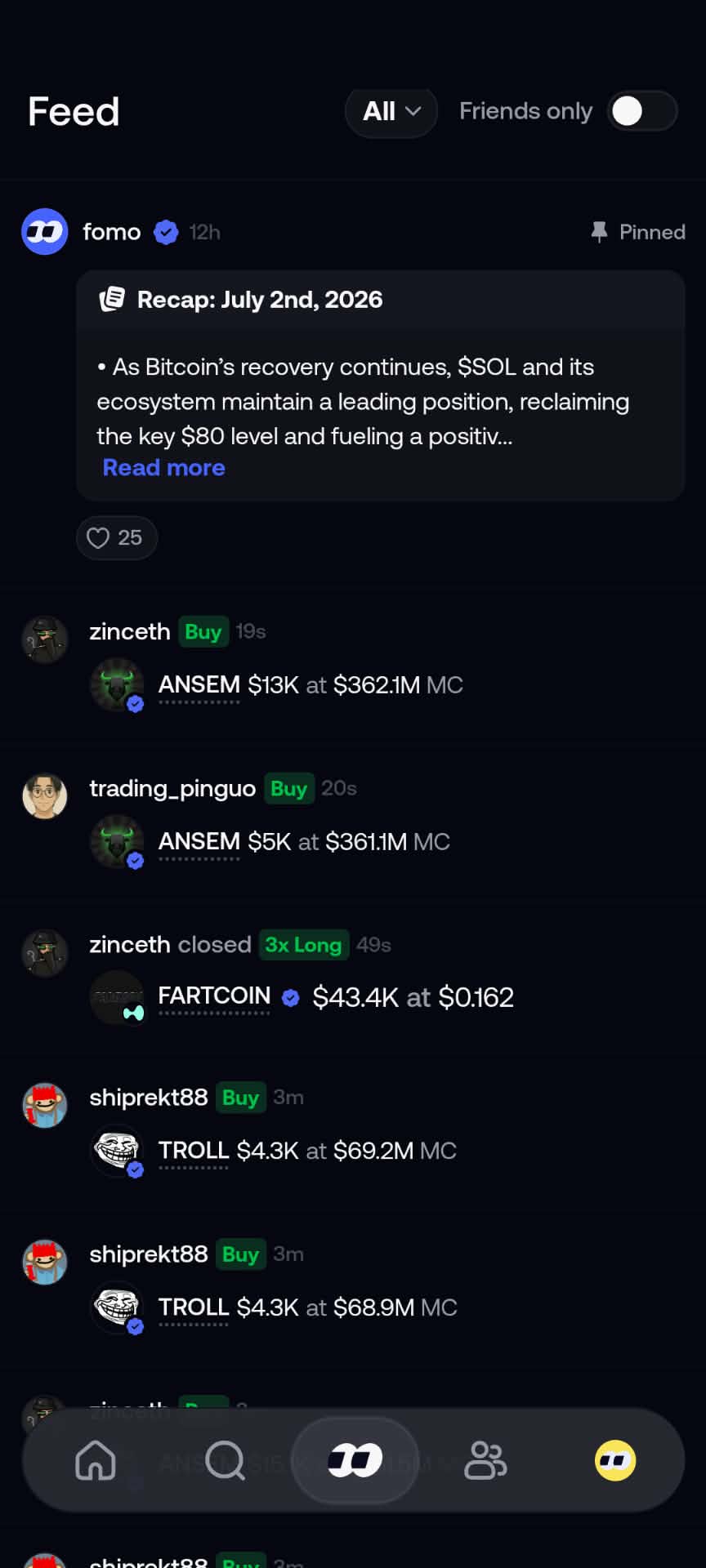
The Feed shows real-time buys, sells, and closed positions from traders across the platform — filterable to "Friends only" if you just want your follows, or left global to see where a crowd is moving. The Fomo team also posts pinned daily market recaps directly into the Feed (e.g. a "Recap: [date]" breakdown of what moved and why), so you get context, not just a wall of trade notifications.
In August 2026 Fomo promoted the friends view to its own tab at the top of the app, so the people you follow now have a dedicated feed rather than a filter you have to reapply. Small change, but it's the difference between checking your follows as a habit and checking them when you remember to.
Recommended Follows: Solving "Who Do I Even Follow?"
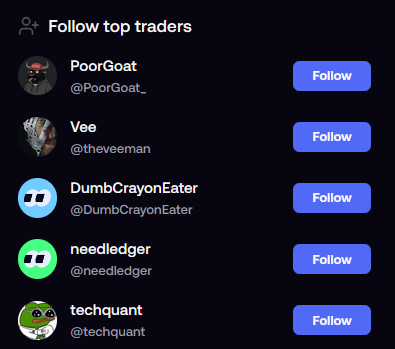
New to this and don't know who's worth watching? Fomo surfaces a curated list of top traders to follow on sign-up, with their handles right there. It's a small feature, but it directly answers the question that stops most beginners cold — there's a real skill in learning who to follow and when to actually copy them, and starting from zero is the hardest part.
Search results now carry each user's follower count and PnL as well, so you can size someone up before tapping into their profile. Useful, with one caveat worth holding onto: both numbers describe what a trader has already done. A high PnL is often the tail end of one position that worked, and followers measure popularity rather than skill. Treat them as a way to shortlist people, then read the actual trade history before you copy anyone.
Thesis: Trades With Their Reasoning Attached
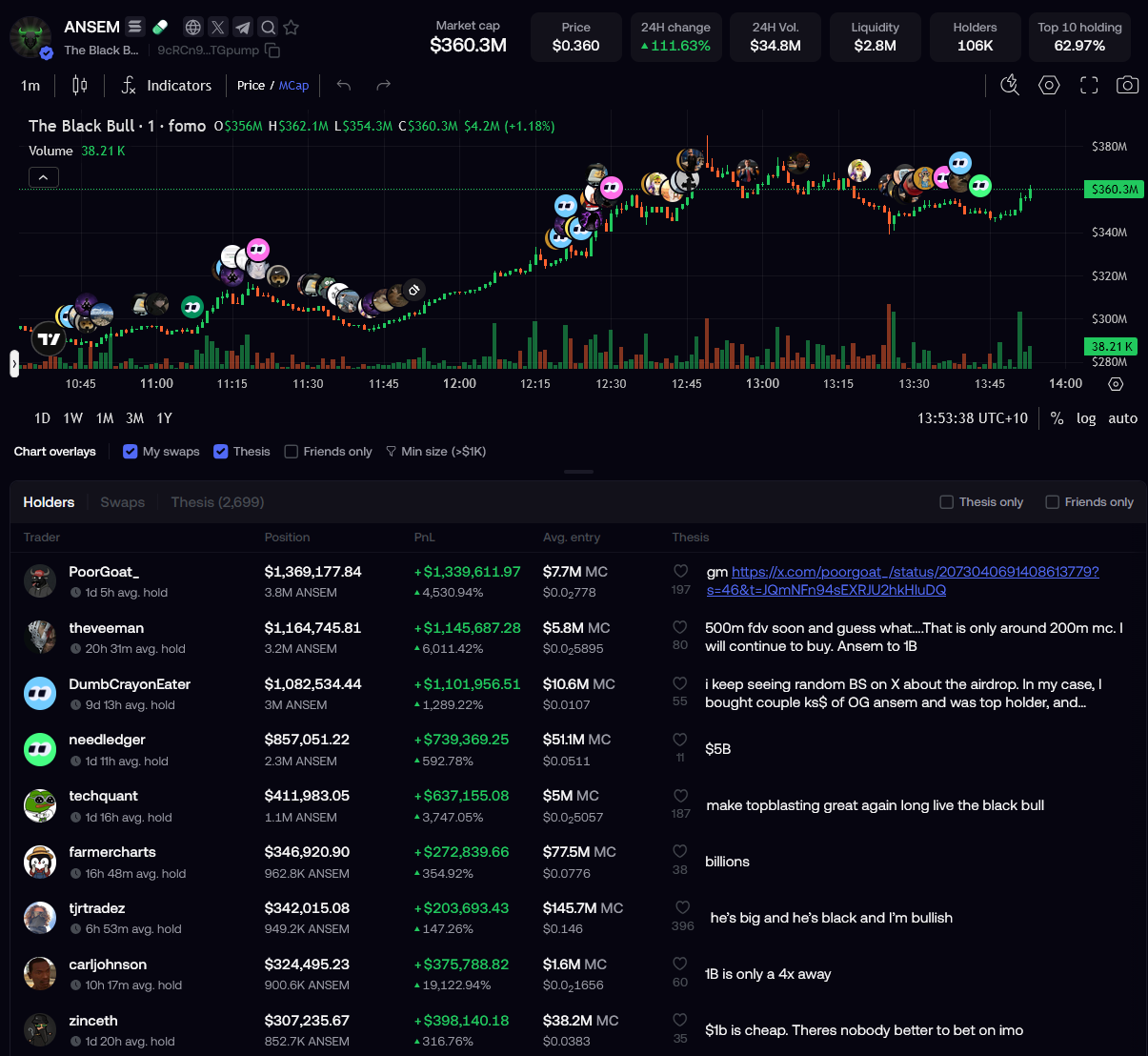
This is the feature most reviews miss entirely. On the desktop web app especially, Fomo plots every tracked trader's buys and sells as small avatar icons directly on the token's price chart, right at the price point where they traded — you can see exactly who bought a dip or sold a top, visually, without digging through a table. Switch to the "Thesis" tab under a token and you get each holder's actual written reasoning next to their position size and live PnL — not just "bought at $X," but why they bought, in their own words.
Clans: Trading as a Named Group
Clans arrived in beta in August 2026 and are the newest layer on top of all this: you form a group, trade under its banner, and the group gets ranked against other clans on its own leaderboard. Every social feature above operates on individuals, so this is the first one that treats a set of traders as a unit — the natural home for a trading group chat that already exists somewhere else, or for a trader with an audience who wants their followers in one place.
Worth going in with clear eyes about what a leaderboard rewards. The way to climb one is to post a bigger number than the clan above you, and the reliable way to post a bigger number is to take more risk with more size. That incentive sits underneath every ranked trading product, and it doesn't stop applying because the ranking is a group. Fun as a social feature; a poor reason to change your position sizing.
Referral link — SellThePump earns a credit if you use it, at no extra cost to you.
The Fee Almost Nobody Mentions: 0.05% on Blue Chips
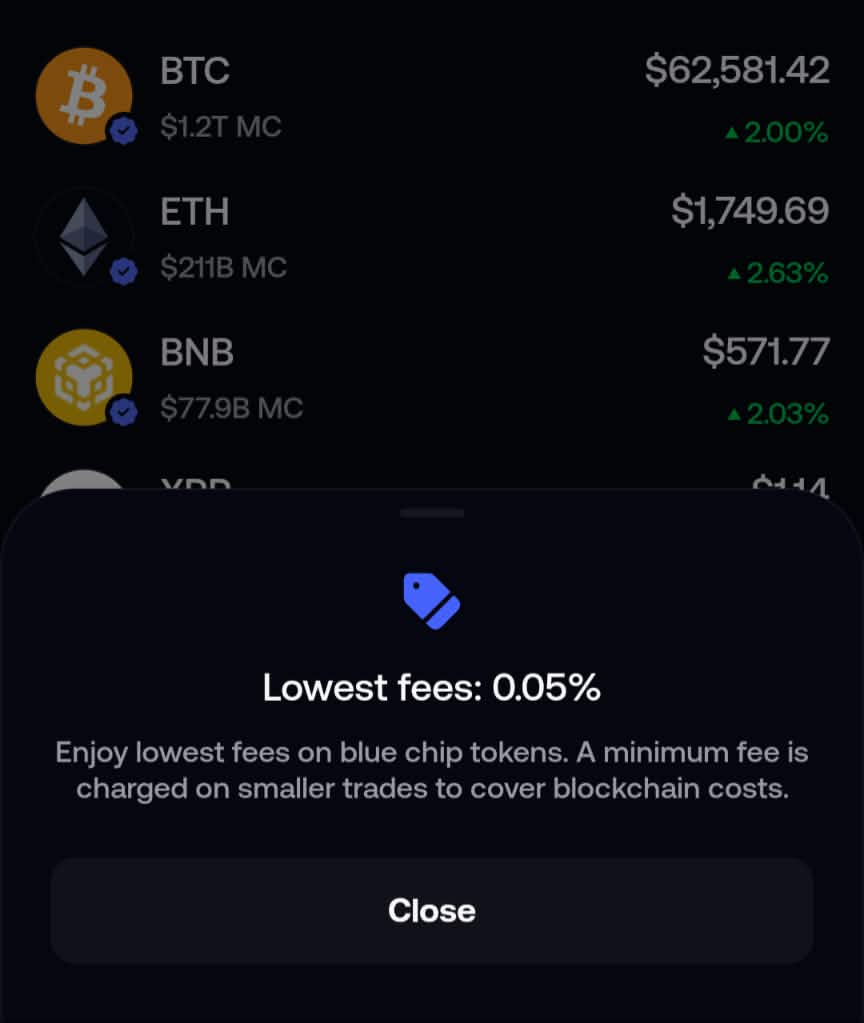
Fomo's memecoin fee is the one most comparisons quote — roughly 0.5% per trade, charged on buys and sells, with no subscription and no separate platform fee on top. By Solana-bot standards that's cheap: most of the field sits around 0.9–1%. What's much less known: Fomo separately advertises a 0.05% fee on blue-chip tokens — BTC, ETH, BNB, and similar established assets — a minimum still applies on smaller trades to cover blockchain costs, but on size, 0.05% is aggressively cheap. It means you can hold and trade majors on the same app you use for memecoins, at a rate closer to a centralized exchange than a typical Solana bot.
What You'd Actually Pay, With the Code
Three real scenarios, code iamsmart applied (10% off):
- • $50 trade (scalper): $0.855 in fees (1.71% effective) — the $0.95 per-trade minimum applies here, not the 0.5% headline rate.
- • $500 trade (regular trader): $2.25 in fees (0.45% effective).
- • $5000 trade (whale): $23 in fees (0.45% effective).
Trade smaller than about $190 and you're paying that minimum, not the percentage — see the fee calculator for your own trade size, or the minimum-fee section just below.
The minimum fee, and where it stops biting
Fomo applies a minimum of about $0.95 per trade. If 0.5% of your trade is less than that, you pay the floor instead — which barely registers on a $300 trade and turns a $20 trade into an effective ~4.75%. The crossover sits at roughly $190 per trade: above it you pay the percentage, below it you pay the floor. Ten $20 trades cost about $9.50 in fees; one $200 trade costs about $1.00. If you trade small, batch up.
With referral code iamsmart the 0.5% becomes 0.45% on trades above the minimum — 10% off, permanently, attached at sign-up only. The full mechanics live on the Fomo referral code page.
And the honest footnote to all fee math on memecoins: the trading fee often isn't your biggest cost. Slippage and price impact on thin, low-liquidity coins can dwarf any 0.5%, and that cost is set by the market, not the app. The numbers above are the floor on what a trade costs, not the ceiling — factor in the spread before sizing up on anything illiquid. What each bot charges at your own trade size is on the fee calculator.
One App, Both Screens
Fomo's onboarding pitch is mobile — that's genuinely where it's strongest and where most users start. But the desktop web app is a full, capable version of the same experience, not a stripped-down companion. If the social layer is what you're actually here for, you can run it on a monitor with the chart overlays and Thesis tab open just as easily as on your phone, and your wallet carries across both — one account, one balance, either screen.
Charting on both screens was rebuilt in August 2026 — pinch and zoom gestures on mobile, and faster rendering on the web app. Charts have been the clearest gap between phone apps and desktop terminals, and it's the reason plenty of people still open a laptop to make the actual call even when they place the trade on their phone. How far this closes that gap is a question of degree rather than a yes or no, and it's worth judging on your own charts before you retire the laptop.
Who Fomo Is Actually For
Honest segmentation: if you're new to memecoin trading, unsure what to buy, or you learn better by watching what good traders actually do and why, the social layer is a genuine advantage — discovery and copy-trading aren't a gimmick here, they're the product.
If you're an experienced trader who'd rather form your own view from raw data, a lot of this is noise you'll want to turn off. Axiom gives you richer, more advanced token stats and analysis tools to make independent calls, with less social layer in the way. Neither is "better" outright — it's a fit question. See the full breakdown in Axiom vs Fomo.
Build Your Own Following
One niche upside worth naming: the social layer runs both ways. If you're actually good at this, people follow you. Your trades, your Thesis notes, and your track record are visible the same way the traders you follow are — a real, if small, way to build a reputation as a trader rather than just executing quietly.
Fomo Also Trades Robinhood Chain Memecoins
Fomo already runs one balance across Solana, Base, BNB Chain, and Monad — Robinhood Chain (Robinhood's own blockchain, live since July 1, 2026) is the newest addition. CASHCAT, the chain's breakout memecoin (a revival of Robinhood's own forgotten pre-launch name), trades the same way as anything else in the app: no separate wallet, no manual network setup, no bridging. Same account, same 10% code, one more chain.
Five chains in one feed gets noisy, which is presumably why Fomo added chain filters to the home screen in August 2026. If you only trade Solana you can now filter the home page down to Solana and stop seeing the rest — and if you want to watch what's happening on Robinhood Chain specifically, the filter works the same way in reverse.
Robinhood Chain is still a young venue with anonymous devs launching tokens on it, so the "new venue, new risk" caveat applies here as with any fresh memecoin market. The same August update added dev tags, which surface updates a token's developer has posted inside the app — a quick read on whether there's a human behind a token or whether it was launched and abandoned. Anyone willing to type can post one, so treat it as a signal rather than a verdict, and keep using the Feed and Leaderboard to see what traders are actually doing rather than following whatever ticker is trending.
Pros & Cons
Pros
- Easiest onboarding of any bot here — Apple or Google sign-in, then Apple Pay, card, or a crypto deposit
- Social feed and alerts: follow traders and see every buy and sell live
- Phone and desktop web app share one account and balance
- 0.5% fee — about half of Axiom's 1% on trades above roughly $190
Cons
- Newer than Axiom
- Built around following traders — fewer token-discovery and analysis tools than Axiom if you trade on your own research
- $0.95 minimum fee makes trades under about $190 relatively expensive
- Copying a trader is manual — GMGN is the tool that automates it
Is Fomo Safe?
Fomo is self-custodial — you hold your own keys, and the platform can't access your funds without your authorization. That covers platform risk. Memecoin trading risk is a separate matter, and it's real regardless of which app you use.
Read the full Fomo safety reviewFrequently Asked Questions
Is Fomo good for beginners?
Yes, more than most Solana bots — the Apple Pay onboarding skips the wallet-setup wall, and the Feed, Leaderboard, and Recommended Follows are built specifically to help someone new figure out who to watch and copy. Experienced traders who prefer working from raw data often find the same social layer unnecessary.
Does Fomo have a desktop app?
Yes — a full desktop web app, not a stripped-down version. It carries the same wallet and balance as the mobile app, so you can use either screen for the same account.
Does Fomo have lower fees on Bitcoin or Ethereum?
Yes — Fomo advertises a 0.05% fee on blue-chip tokens like BTC, ETH, and BNB, separate from its ~0.5% memecoin fee (a minimum fee still applies on small trades to cover blockchain costs).
What are Fomo clans?
Clans are Fomo's group feature, in beta since August 2026: you form a named group, trade under it, and the group is ranked against other clans on a clan leaderboard. It's the first Fomo social feature that treats a set of traders as a unit rather than as individuals. As with any ranked trading product, climbing the leaderboard rewards bigger positions, so treat it as a social feature rather than a reason to size up.
What is the Thesis feature on Fomo?
Thesis shows each tracked trader's written reasoning for a position alongside their position size and live PnL, and plots their buys/sells directly on the token's price chart — you see not just what they traded, but why, in their own words.
Why did a small Fomo trade cost more than 0.5%?
Because of the per-trade minimum. If 0.5% of your trade is less than about $0.95, you pay the $0.95 floor instead — roughly 4.75% effective on a $20 trade. The minimum stops mattering once a trade exceeds about $190, so fewer, larger trades cost less in fees than many small ones.
Does Fomo have a subscription or hidden fees?
No subscription. The per-trade fee is how Fomo makes money. The other costs you'll feel are market costs rather than Fomo's: price impact and slippage on low-liquidity memecoins, which can easily exceed the trading fee itself.
Is Fomo or Axiom better?
They're built for different traders. Fomo's social layer (Feed, Leaderboard, Thesis) is genuinely useful if you're newer or like learning from others; Axiom gives more advanced independent analysis tools with less social layer. Full comparison in Axiom vs Fomo.
Can I trade Robinhood Chain memecoins (like CASHCAT) on Fomo?
Yes — Fomo added Robinhood Chain as one more supported chain shortly after its July 1, 2026 launch, alongside Solana, Base, BNB Chain, and Monad. Same account, same 10% code, no bridging required.
Referral link — SellThePump earns a credit if you use it, at no extra cost to you.